
If you’ve been living with a missing tooth for a while, you aren’t alone. We talk to patients every week who have put off tooth replacement for years. Sometimes it’s because life simply got in the way, or perhaps the cost felt like a lot at the time, or maybe—like many people—the thought of dental surgery felt a bit daunting.
But as the years pass, a common worry starts to set in: “Have I left it too late? Is the gap permanent now?”
It’s a valid concern. You might have noticed your other teeth shifting, or perhaps you’ve heard that the bone “disappears” after a while. The good news is that it is almost never too late. Even if it’s been five, ten, or twenty years, modern dentistry has some incredibly clever ways to make a dental implant possible. However, the “road to an implant” might look a little different than it would have a decade ago.
What Actually Happens to Your Jaw Over Time?
To understand why time matters, you have to look at how your jawbone functions. Your jawbone is a bit like a muscle; it needs “exercise” to stay strong and healthy. In this case, that exercise comes from the tooth root. Every time you chew, the root sends vibrations into the bone, signalling the body to keep that area dense and strong.
The moment a tooth is lost, that stimulation stops. Your body, being efficient, decides it no longer needs to maintain bone that isn’t doing any work. This leads to a process called resorption.
The “Secret Weapon”: How We Rebuild the Foundation
If you’ve been told in the past that you “don’t have enough bone” for an implant, don’t lose heart. Technology has moved on significantly. We now have several ways to “rebuild” the site so it’s ready for a permanent tooth.
Bone Grafting
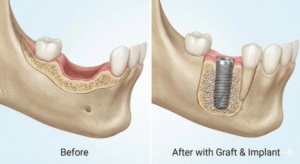
This is the most common solution. If the bone has thinned out over the years, we can perform a minor procedure to add volume back. We essentially place a small amount of bone-grafting material into the site. This material acts as a “scaffold.” Your body sees it and starts to grow its own new, natural bone around it. After a few months of healing, you have a solid, sturdy foundation that can hold an implant just as well as a fresh site would.
Sinus Lifts
If you are missing back teeth in your upper jaw, there’s an extra challenge: the sinuses. When upper teeth are gone for a long time, the sinus cavity can actually expand downwards into the space where the tooth roots used to be. A “Sinus Lift” is a sophisticated procedure where we gently nudge the sinus floor back up to its original position, creating enough room to place an implant safely.
Advanced 3D Imaging
Years ago, dentists had to rely on 2D X-rays, which didn’t show the full picture. Today, we use CBCT scans. These give us a 3D map of your jaw, down to the millimetre. We can see exactly how much bone is left, where the nerves are, and exactly where the implant needs to go before we even begin the procedure.
Frequently Asked Questions About Long-Term Implants
Is the surgery more painful if I’ve waited longer?
Not at all. The implant procedure itself is performed under local anaesthetic, so you won’t feel a thing. If you need a bone graft, that might add a bit of time to the overall healing process, but the day-to-day discomfort isn’t significantly different from a standard implant.
How many appointments will it take?
If you need a bone graft, it does require a bit of patience. Usually, we place the graft and let it “integrate” for 3 to 6 months. Once the bone is solid, we place the implant. It’s a marathon, not a sprint, but the result is a tooth that can last the rest of your life.
What if my other teeth have already shifted?
If your teeth have drifted so much that the gap has partially closed, we might suggest a short course of clear aligners (like Invisalign) to move them back into their proper places before we place the implant.
Why It’s Better to Act Now Than Later
The best reason to get an implant—even if you’ve waited twenty years—is that it stops the clock. A dental implant is the only tooth-replacement option that acts like a real tooth root. Once it’s in, the bone resorption stops. You’re essentially “freezing” your jawbone health in place and protecting the rest of your teeth from shifting further.
Restoring Your Confidence at Pinner Green Dental Clinic
At Pinner Green Dental Clinic, we’ve seen it all. We have helped patients who thought their smiles were a “lost cause” because they had been missing teeth since their twenties.
We don’t believe in rushing people. Our process starts with a thorough 3D scan and a long chat. We look at your bone density, your overall health, and what you actually want your smile to look like. If you need a bone graft or a sinus lift, we explain exactly why and how it works so there are no surprises. Our goal is to make sure that when we finally place that crown, it doesn’t just look like a tooth—it feels like your tooth.
If you’re tired of avoiding certain foods or hiding your smile in photos, come and talk to us. Whether it’s been two years or two decades, your journey back to a full, functional smile is still very much an option. Contact the team at Pinner Green Dental Clinic today for a consultation. Let’s take a look under the surface and figure out a plan that finally works for you.
< Back to Blog